Hey Hunters,
lpTOKEN.fun is our new trading platform where every token comes in two forms: the coin itself, and its liquidity pool turned into a token (called, lpTOKEN) that earns a cut of every trade. Believe in the price, buy the coin. Believe in the trading volume, buy the lpTOKEN.

It is live now on Robinhood Chain and Base.
1. A token’s LP is now a tradable asset
Every token trades through a liquidity pool, and that pool earns a fee on every single trade. Until now, owning a piece of it meant running an LP position yourself: two-sided deposits, dashboards, range management.
lpTOKEN.fun tokenizes the pool position itself. Each market gets an lp{TOKEN}: mint it and you own a share of the pool and the fees it earns. Redeem it whenever you want. Price risk and impermanent loss do not disappear; what disappears is the job of managing a position. It is just a token you hold.
2. Trade the volume, not just the price
This is the core of it. Until now there was only one way to have an opinion on a memecoin: its price.
lpTOKEN adds a second axis. The pool earns from volume, green candles and red candles alike. A meme coin asks one question: will the price go up? An lpTOKEN asks a different one: will people keep trading it? If your answer to the second is yes, that is now a position you can take. Price traders and volume traders, in the same market.
3. Sometimes the LP is the better trade
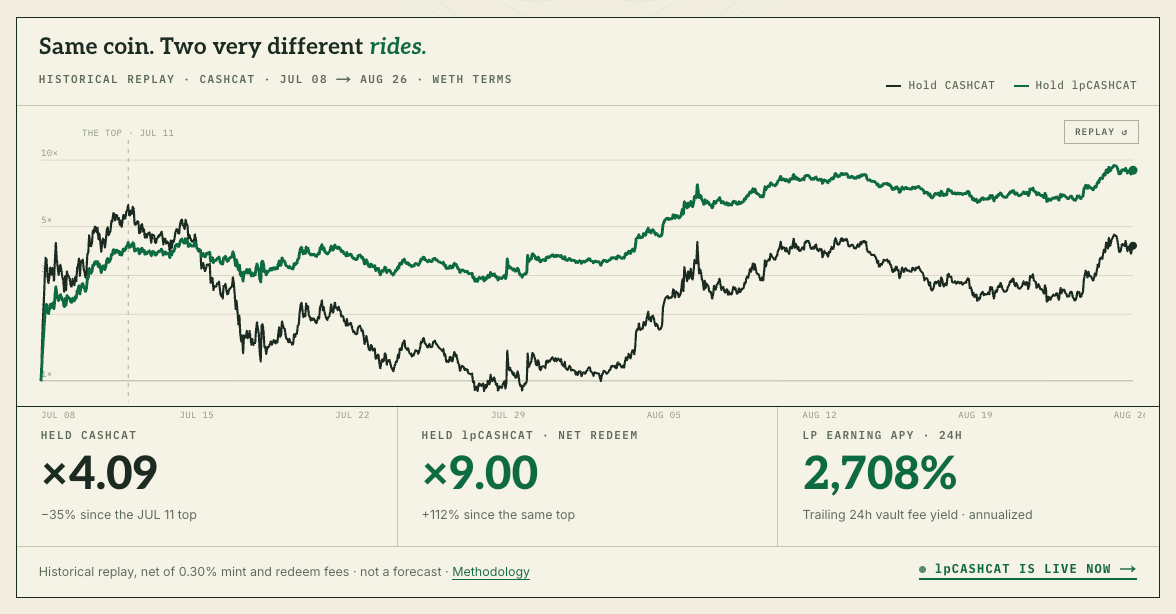
Not always. But when a coin trades hard relative to the size of its pool, fee income piles up fast, and the markets page shows both sides next to each other:
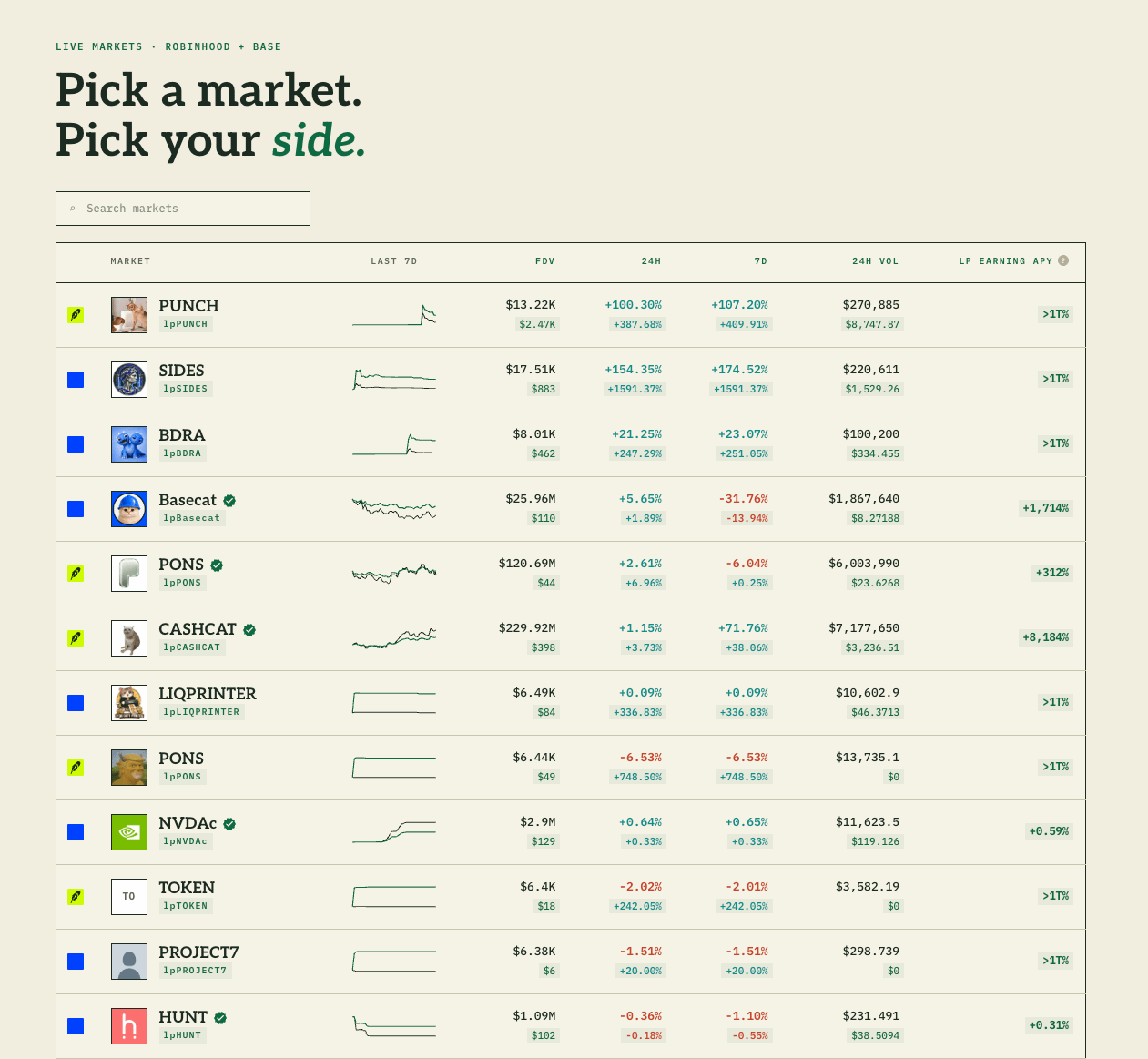
Look at the 7-day column. PUNCH is up 100% while lpPUNCH is up 410%. SIDES is up 174% while lpSIDES is up 1,591%. Heavy trading paid the pool more than the price move paid holders.
And it works on the way down too. Basecat is down 31%, but lpBasecat is only down 13%: the pool damps price swings and keeps collecting fees whichever way the candles point.
Every market page has a chart comparing both sides, so you can check this for any token before touching it. (Live figures at the time of the snapshot; they move with the market. A quiet pool earns quiet fees, and a sharp one-way move can favor simply holding the coin.)
4. Stocks just joined, and the LP side gets even more interesting
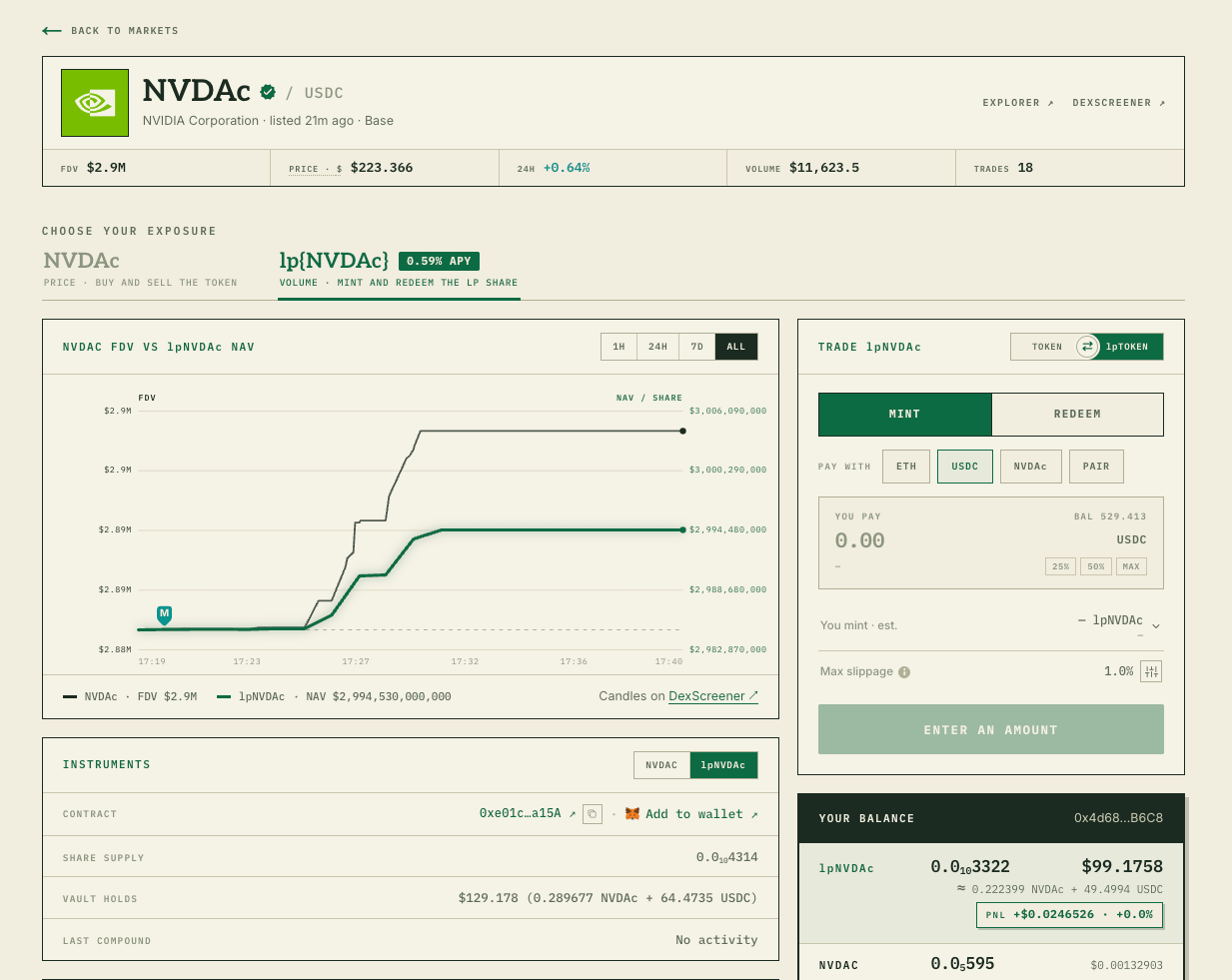
We just listed our first tokenized stock market on Base: NVDAc (NVIDIA), paired with USDC. And an lp{STOCK} is a different animal from a meme pool, in three ways:
You could never own this before. Buying a stock is easy. Owning the market that trades it has always belonged to institutional market makers. lpNVDAc is a slice of the trading venue for NVIDIA, and there is no retail equivalent of that in traditional finance.
Half the position is stablecoin. The pool holds the stock against USDC, so minting gives you roughly half stable value. Price moves hit the position at about half strength, while fees accrue on every trade, around the clock, no market hours.
The math gets friendlier. A meme coin can round-trip 90% in a week, which drags its LP down with it. Stocks move in single digits on a big day, so more of what an lp position earns comes from fees rather than price luck.
These markets are brand new, so the same rule applies: fees follow volume. But structurally, stable-quoted, lower-volatility markets are exactly where the LP side shines.
5. Launch a token with both sides built in
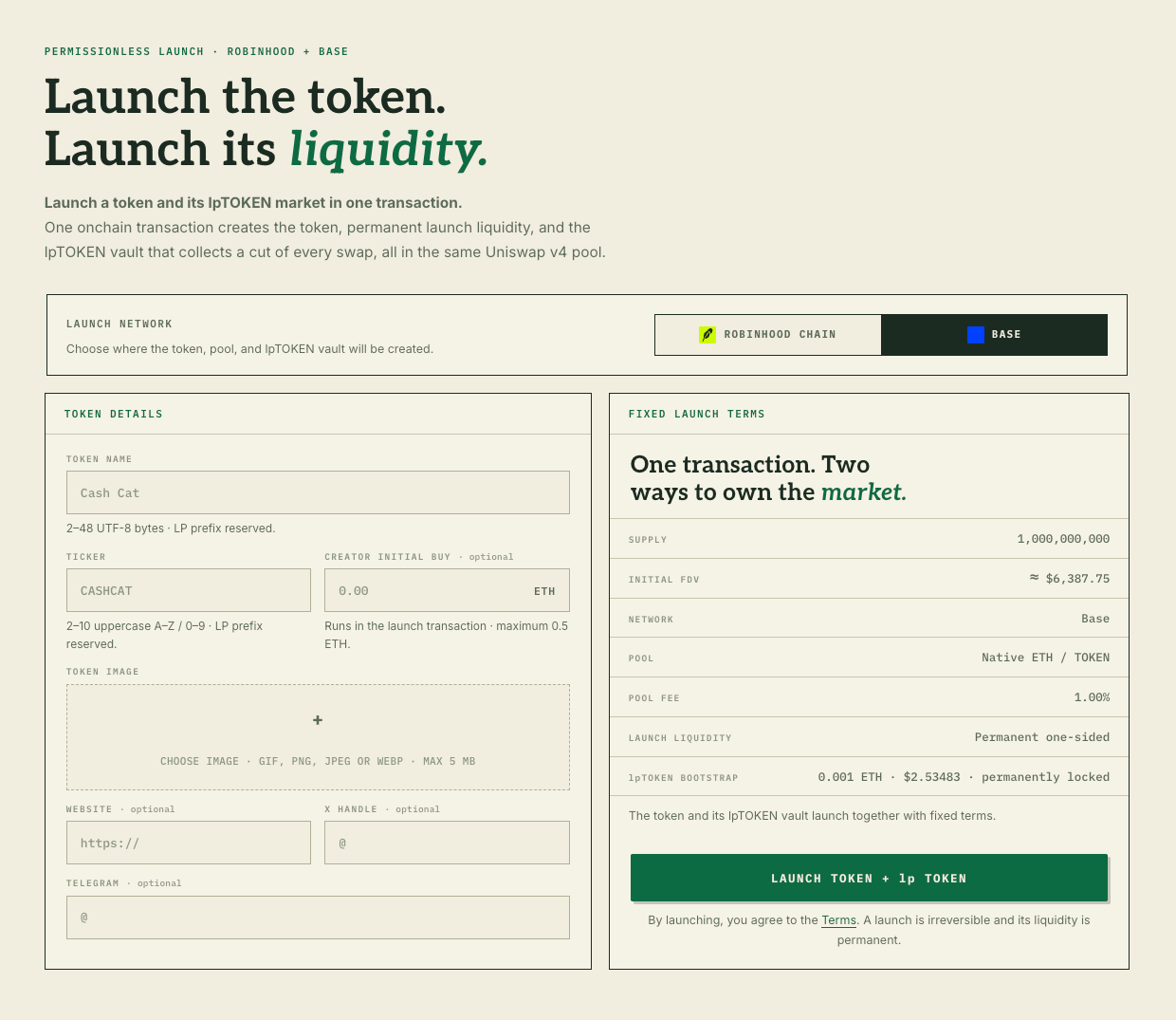
There is also a launchpad. One transaction mints the whole market: the token, permanent launch liquidity that can never be pulled, and its lpTOKEN vault, all in one Uniswap v4 pool. No presale, no team allocation.
That means new tokens are dual-sided from day one: a coin for price traders and an lpTOKEN for volume traders, from the very first trade.